



Introduction
Once kidney stones are identified, many patients begin to ask what happens next. While some stones may pass naturally, others may require further medical attention depending on their size, location, and associated symptoms.
Understanding the available treatment options for kidney stones can help guide informed decisions about care.
If you are experiencing ongoing pain or urinary symptoms, an assessment may help determine the most appropriate next step.
Do All Kidney Stones Require Treatment?
Not all kidney stones require active treatment.
In some cases, particularly when stones are small and symptoms are manageable, they may pass naturally with supportive care such as hydration and monitoring.
However, treatment may be considered when:
- Pain is severe or persistent
- The stone is unlikely to pass on its own
- There is obstruction of urine flow
- There are signs of infection
The decision to treat is based on individual clinical findings rather than a single factor.
What Factors Influence Treatment Decisions?
The most appropriate approach to managing kidney stones depends on several factors, including:
- Size of the stone – Larger stones are less likely to pass naturally
- Location – Stones in the ureter are more likely to cause symptoms
- Severity of symptoms – Pain, nausea, and urinary difficulty may influence management
- Overall health and medical history
- Previous history of kidney stones
Assessment helps guide a treatment plan that is appropriate for each individual.
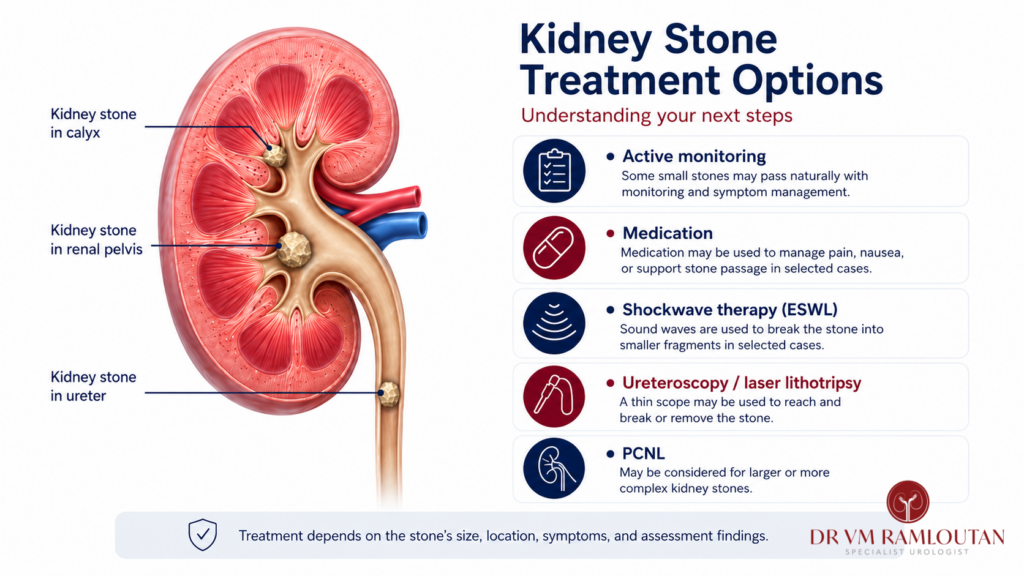
Kidney Stone Treatment Options
At this stage, many patients are considering whether symptoms will settle or require further intervention.
There are several approaches to managing kidney stones:
1. Conservative Management
For smaller stones, treatment may involve:
- Increased fluid intake
- Pain management
- Monitoring over time
This approach allows the stone to pass naturally where possible.
2. Medication
In some cases, medication may be used to:
- Help relax the urinary tract
- Support stone passage
- Manage symptoms
Medication is usually considered based on the size and location of the stone.
3. Shockwave Therapy (ESWL)
Extracorporeal Shockwave Lithotripsy (ESWL) uses sound waves to break stones into smaller fragments that may pass more easily.
This option may be considered in selected cases depending on stone characteristics.
4. Minimally Invasive Procedures
When stones are larger or unlikely to pass, minimally invasive procedures may be considered.
These may involve:
- Passing instruments through the urinary tract
- Breaking or removing the stone directly
The choice of procedure depends on the individual situation and clinical findings.
When Is Treatment More Likely to Be Needed?
Treatment may be considered when:
- Symptoms are severe or ongoing
- Stones are unlikely to pass naturally
- There is obstruction of urine flow
- There is risk of complications such as infection
Early assessment can help determine whether intervention is appropriate.
What to Expect from an Assessment
If kidney stones are suspected, an assessment typically involves:
- A discussion of your symptoms
- A clinical examination
- Urine and blood tests
- Imaging such as ultrasound or CT scan
The purpose of assessment is to confirm the diagnosis and guide appropriate management.
An assessment typically involves a discussion of your symptoms and may include further evaluation if required.
Understanding Your Next Steps
Kidney stone management is not the same for every patient. Some cases require only observation, while others may benefit from procedural treatment.
The most appropriate approach is determined after careful assessment of symptoms and clinical findings.
Summary
Kidney stones can vary in how they present and how they are managed. While some may pass without intervention, others may require treatment depending on individual factors.
Understanding the available options can help you feel more informed when discussing your care.
If you are experiencing symptoms related to kidney stones, an assessment may help determine the most appropriate next step.
If you are experiencing persistent pain, difficulty passing urine, or ongoing discomfort, an assessment may help determine the cause and guide appropriate management.
Learn more about kidney stone symptoms and when to see a specialist
Disclaimer
This article is intended for informational purposes only and does not replace professional medical advice, diagnosis, or treatment. Individual care decisions should always be made in consultation with a qualified healthcare professional.